How to Fix a Garage Door Spring: Safe Steps and When to Call a Pro
Last Updated: October 27, 2026
Quick Summary
Fixing a garage door spring is not a safe DIY job: industry guidance advises homeowners never to remove, repair, or adjust springs, and a broken spring stores enough energy to cause severe injury in a fraction of a second. Instead, confirm the break by looking from a distance, then call a professional. Typical single torsion spring replacement runs $150-$350.
- A loud bang, a visible coil gap, or a door that opens a few inches and stops signals a broken spring.
- A torsion spring is a horizontal coil above the door; an extension spring stretches along the side tracks.
- Amarr advises homeowners never to remove, repair, or adjust garage-door springs, favoring visual inspection instead.
- Paired torsion spring replacement typically costs $250-$500, and after-hours calls add $75-$200.
- A standard spring is rated for roughly 10,000 cycles; high-cycle springs for 20,000-25,000 cycles cost more upfront.
Table of Contents
- Diagnosing Broken Garage Door Spring Symptoms Before You Touch Anything
- Torsion Spring vs. Extension Spring: Which System You Have
- Garage Door Spring Safety: The Decision Tree That Keeps You Out of the ER
- Garage Door Spring Repair Cost: What Drives the Number
- Step-by-Step: How to Fix a Garage Door Spring Safely
- Schedule Your Spring Repair With Eidelberg Garage Doors
- Frequently Asked Questions
Diagnosing Broken Garage Door Spring Symptoms Before You Touch Anything
A broken garage door spring is one of the few home repairs where the diagnosis matters more than the fix. According to a peer-reviewed case report on open-globe eye injuries from garage door springs, seven patients sustained serious eye injuries when a spring dislodged at high velocity during attempted repairs. That single fact should shape how you approach this job.
Here is how to identify signs of a broken spring.
Signs the Spring Has Failed
The most common sign: the door will not open, or it opens a few inches and stops. Other symptoms include:
- A loud bang from the garage
- A visible gap in the spring coil above the door
- The door feels extremely heavy when you try to lift it by hand
- The opener strains or hums but the door barely moves
- The door hangs unevenly, with one side sagging
If you hear that bang, stop using the opener.
Confirming the Diagnosis Without Risking Your Hands
Look, do not touch. Stand back with a flashlight. On a torsion system, a break may show a clear gap between the halves. On an extension system, a spring may appear stretched or separated along the side tracks.
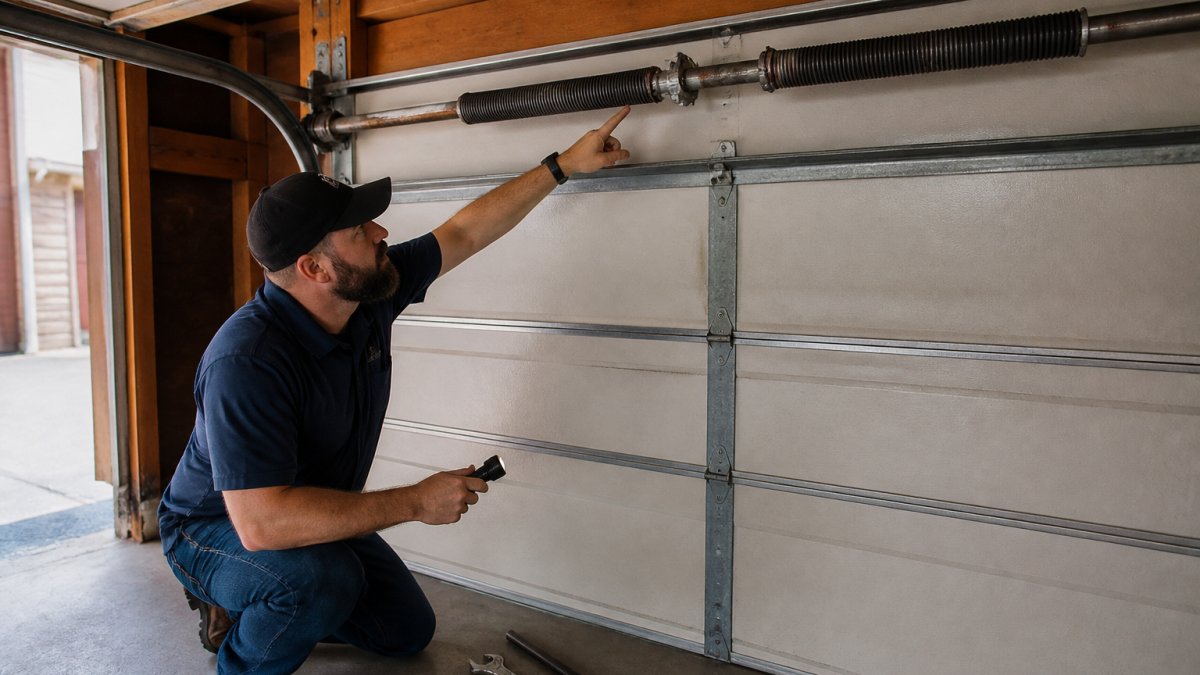
Never feel for the break with your fingers or wind a spring to "test" it. Those coils hold enough stored energy to cause serious injury.
Torsion Spring vs. Extension Spring: Which System You Have
A torsion spring is a horizontal coil mounted on a metal bar above the garage door. It twists to lift the door through cables and drums; most modern doors use this setup because it is quieter and lasts longer.
Garage Door Extension Spring Replacement
House Doctor Ray
An extension spring is a stretched coil that runs along the horizontal tracks on each side of the door. These stretch rather than twist and usually have a safety cable through the center. Quick comparison:
| Feature | Torsion Spring | Extension Spring |
|---|---|---|
| Location | Above the door on a bar | Along side tracks |
| How it works | Twists to lift | Stretches to lift |
| Typical cycle life | Higher | Lower |
| DIY difficulty | High risk | High risk |
| Safety cable needed | No | Yes, always |
Garage Door Spring Safety: The Decision Tree That Keeps You Out of the ER
Garage door spring safety comes down to one question: should you be doing this at all?
A broken garage door spring stores enough energy to cause severe injury in a fraction of a second. The injury case report we cited earlier is not an outlier. It is a warning.
- Door will not move and you see a snapped spring? Stop. Call a professional.
- Spring looks intact but the door is heavy or uneven? Stop. This points to a cable or balance problem that is just as dangerous.
- You have the correct replacement spring, proper winding bars, and prior experience? A torsion spring swap is possible but still risky.
- You have never worked on a spring before? Do not start now.
When DIY Is Reasonable and When It Is Not
It does not make sense for winding, removing, or adjusting springs. Industry guidance is blunt on this point. Amarr, cited in a garage door safety guide, advises homeowners never to remove, repair, or adjust garage-door springs, favoring periodic visual inspection instead. A separate repair guide calls spring work a safety-sensitive job and recommends professional help over DIY replacement.
Garage Door Spring Repair Cost: What Drives the Number
Garage door spring repair cost depends on the work required. Contact Eidelberg Garage Doors for a quote.
Typical Cost Ranges by Repair Type
| Repair Type | Typical Range (Parts + Labor) | Notes |
|---|---|---|
| Single torsion spring replacement | $150-$350 | Most common residential job |
| Paired torsion spring replacement | $250-$500 | Recommended when both springs are the same age |
| Single extension spring replacement | $100-$250 | Lower parts cost, similar labor |
| Paired extension spring replacement | $180-$400 | Safety cables should be replaced at the same time |
| Cable replacement (per side) | $100-$250 | Often bundled with spring work |
| Emergency or after-hours call | Add $75-$200 | Nights, weekends, holidays |
What Actually Drives the Price
- Spring type. Torsion work requires winding bars, precise tensioning, and more skill, so it costs more than faster extension work.
- One spring or two. Replacing a pair at once usually saves $75-$150 in labor versus two visits.
- Spring cycle life. A standard spring is rated for roughly 10,000 cycles; a high-cycle spring rated for 20,000-25,000 cycles costs more upfront but can outlast two standard springs. Ask what cycle rating is being installed.
- Door size and weight. A heavier door needs a stronger, costlier spring; oversized or custom doors can push the job above these ranges.
- Related damage. A snapped spring can bend a track, snap a cable, or damage a drum, typically $100-$250 per component.
Time Expectations
A single torsion spring replacement takes an experienced technician 45 to 90 minutes; paired springs, cable work, or track straightening can push it past two hours. Extension spring replacement is often 30 to 60 minutes per side. If a quote adds a vague "diagnostic fee," ask whether it is credited toward the work.
Step-by-Step: How to Fix a Garage Door Spring Safely
This section explains how a spring replacement actually works so you understand what a technician is doing, why it takes the time it does, and what to check before you sign off on the job. It is not a green light to attempt it yourself. The stored energy in a wound torsion spring is enough to cause serious injury in a fraction of a second, and the injury case report cited earlier shows what happens when that energy releases unexpectedly.
Step 1: Release Tension and Lock the Door
This is the most dangerous step: the spring is under full tension, and one wrong move releases it all at once. A common failure is losing grip on a winding bar mid-wind; the bar can spin free with enough force to break a wrist or worse.
Step 2: Measure, Match, and Install the Replacement Spring
Springs are matched by four numbers: wire diameter, inside diameter, spring length, and wind direction (left- or right-hand). A technician measures the old spring with calipers, orders an exact match, and slides it onto the torsion bar, followed by the winding cone, set screws, and cable drums. A mismatched spring will not balance the door and can fail early, which is why paired-spring replacement pays off when both springs share the same age and cycle count.
Step 3: Wind the Spring to the Correct Tension
Torsion springs are wound in quarter-turn increments, typically around seven to eight full turns for a standard seven-foot door. The technician alternates bars, counts turns carefully, then tightens the set screws on the winding cone. Too few turns and the door will not lift; too many and it flies up or the spring is overstressed. There is no safe way to "test" tension by hand during winding.
Step 4: Test Balance and Manual Operation
A balanced door should lift with one hand and stay open at waist height on its own. If it drops or feels
Schedule Your Spring Repair With Eidelberg Garage Doors
At Eidelberg Garage Doors, we have served Brooklyn and Long Island since 1945, with more than 10,000 repeat customers. We offer installation, repair, and emergency service seven days a week.
Call 718-645-2930 to schedule your repair, or reach out for an emergency visit today.
Frequently Asked Questions
How do you know your garage door spring is broken?
A visible gap in a torsion spring coil or a stretched or separated extension spring may indicate a problem. A door that feels heavy, opens only a few inches, or makes a loud bang may also need attention. Contact a professional for an assessment.
How much does garage door spring repair cost?
Contact Eidelberg Garage Doors at 718-645-2930 for current pricing or a quote.
Is it safe to repair a garage door spring yourself?
A published case series documented seven patients with open-globe eye injuries after springs dislodged during repair attempts. For help with garage door spring repair, contact Eidelberg Garage Doors.
Do I need to replace both garage door springs at the same time?
Whether one or both springs need replacement depends on the door and its condition. Contact Eidelberg Garage Doors for an assessment.